Telegram Spanish Vocabulary Channel: How to Find One and How to Join
A free Telegram channel that sends one Spanish word a day, with article, accent and region: how the poll and voice note train rr, ñ and false friends, and four questions to ask any Spanish channel.
Try the AI tutor for freeA Spanish word carries more than its meaning
English speakers usually find Spanish friendly on paper. Lots of vocabulary looks familiar (hospital, animal, posible), spelling is mostly regular, and after a few weeks you can guess your way through a menu. That friendliness hides how much a single Spanish word actually asks you to remember.
Take mano, hand. It ends in o and is still feminine: la mano. Take papá and papa: the accent mark is the only thing between "dad" and "potato". Take a car: coche in Madrid, carro in Bogotá, auto in Buenos Aires. And take embarazada, which looks like "embarrassed" and means "pregnant".
None of that survives a list of thirty words read in one sitting. One word a day, looked at properly, does survive. That is the whole reason we run a Telegram channel that sends a single Spanish word every day, explained in English:
It costs nothing and carries no ads.
Anatomy of a daily post
Each word arrives in the same four-part format, and each part targets something Spanish learners actually trip over.
A three-option poll. You see the word and choose its meaning from three answers before anything else is revealed. Spanish is full of words that look like English and are not, so this guess earns its keep: actual means "current", librería is a bookshop, éxito is success, not an exit. Getting one wrong and seeing the right answer a second later fixes it in memory far better than reading it would.
An explanation that opens after you vote. Once you pick, the example sentence appears. Showing it earlier would hand you the answer.
A voice note. The word on its own, a brief silence, then the full sentence. The silence is your turn to say it out loud. This is where Spanish sounds get trained: the trilled rr that separates perro (dog) from pero (but), the ñ in año, the silent h in hola, and vowels that stay short and pure instead of gliding the way English "o" does in "go". The voices belong to the AI tutors in VocaFlare, our conversation practice app.
The word in bold. Inside the sentence under the audio the word is bolded, so your eyes land on it while your ears hear it.
Joining takes a minute
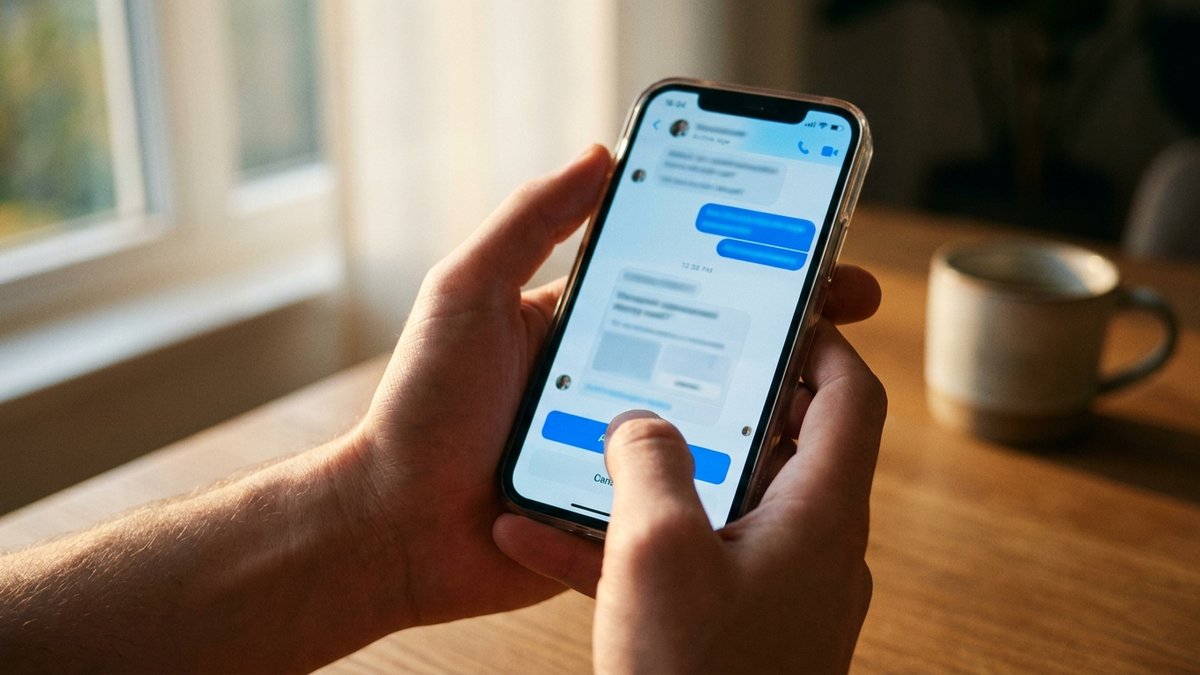
On your phone, tap the link above; Telegram opens and you press "Join". If you don't have Telegram yet, install it first and tap the link again. If you search instead, type @vocaflare_es_en in full, because lookalike channels with one extra letter exist. On a computer, the desktop app or web.telegram.org shows the same channel once you log in with the same account, which is handy for repeating the audio out loud through speakers. Leave notifications switched on for the channel; a word that arrives silently tends to pile up unread.
Four questions to ask any Spanish channel
Ours is not the only one. Whichever you try, check these.
Does it give nouns with their article? Every Spanish noun is el or la, and adjectives agree: el agua fría, la mano izquierda. A noun without its article is half learned.
Are accents and ñ written? tú is "you", tu is "your"; sí is "yes", si is "if". A channel that drops accents or types n for ñ teaches you the wrong spelling from day one.
Does it say where a word is used? ordenador in Spain, computadora across Latin America. Both are correct, but a good channel tells you which is which so you don't sound like you're from two countries at once.
Do the example sentences sound like people? "The book is on the table" is grammatical and useless. A sentence you could hear in a café or read in a text message teaches the word in the way you will meet it.
Turning recognition into speech
A channel brings words to you; it can't put them in your mouth. Spanish makes this gap wider than English does, because verbs change with every person and tense. Knowing hablar does not mean hablé or hablaremos will come out when you need them.
A simple habit helps: the day a word arrives, say two sentences with it, one in the present and one in the past. Then use it in conversation within the week. If you have nobody to talk to, practicing with an AI tutor fills that gap, and that is what VocaFlare is built for.
Not sure where you stand? A Spanish level test takes a few minutes. Starting from nothing? Read the guide on learning Spanish from scratch first. Want more words than one a day? The Spanish word lists by level are there.
Spanish learner questions
Is Spanish pronunciation hard for English speakers?
Mostly no. The big adjustments are keeping vowels short and pure, tapping the single r, rolling the double rr, and the throaty j in words like jamón. Repeating each voice note out loud during the pause is the fastest way to get there.
How do I type ñ and accents on my phone?
Long press: hold n to get ñ, hold a vowel to get á, é and so on. Adding a Spanish keyboard in your settings also gives you ¿ and ¡.
Do I really have to learn the gender of every noun?
Most of it is predictable: -o usually masculine, -a usually feminine. The exceptions (la mano, el día, el problema) only stick if you always see the noun with its article, so read every noun as el or la plus the word.
Spain Spanish or Latin American Spanish?
Both sides understand each other without trouble. Differences are a handful of everyday words, the vosotros form used in Spain, and the "th" sound for z and ce, ci in most of Spain. Pick the accent of the people you will talk to and learn to recognize vocabulary from both.
In short
Spanish words stick when you learn them with their article, their accent and their region, and one a day is enough to do that properly. The channel: t.me/vocaflare_es_en